
APPLICATION ENGINEERING
Thick Film Drying and Firing
Thick film technology is widely used in thick film circuit manufacturing, precision resistors, heaters, sensors, component terminations, and other functional electronic devices. Conductive, resistive, and dielectric pastes are typically deposited onto a ceramic substrate, such as an alumina substrate, or other compatible materials and then processed through controlled drying and firing cycles.
Although printing defines the pattern, the thermal process plays an important role in developing the final electrical and physical properties of the printed layer. Drying removes solvents and stabilizes the printed pattern before firing, while firing removes remaining organic constituents and develops the functional layer under a controlled time-temperature profile.
The required process depends on the paste chemistry, substrate, printed structure, atmosphere, and final product requirements. Furnace selection should therefore be based on the actual drying or firing profile rather than maximum temperature alone.
Typical Thick Film Process
A typical thick film manufacturing sequence can be summarized as:
- Screen Printing
- Leveling
- Drying
- Firing
- Inspection / Additional Print-Fire Cycles
Conductors, resistors, and dielectric layers may require different materials and thermal profiles, and multilayer products may pass through the printing, drying, and firing sequence multiple times. For furnace processing, the two principal thermal stages are thick film drying and thick film firing.
Thick Film Drying
After screen printing and leveling, thick film pastes are dried at relatively low temperature to remove volatile solvents and stabilize the printed pattern before firing. Conventional thick film processes commonly use drying temperatures around 100–150°C, although the actual temperature, time, and heating rate should follow the paste manufacturer's recommendations.
Drying performance depends on more than temperature alone. Heating uniformity, residence time, airflow, exhaust, belt loading, and solvent-vapor removal all influence how consistently the printed layer enters the firing process.
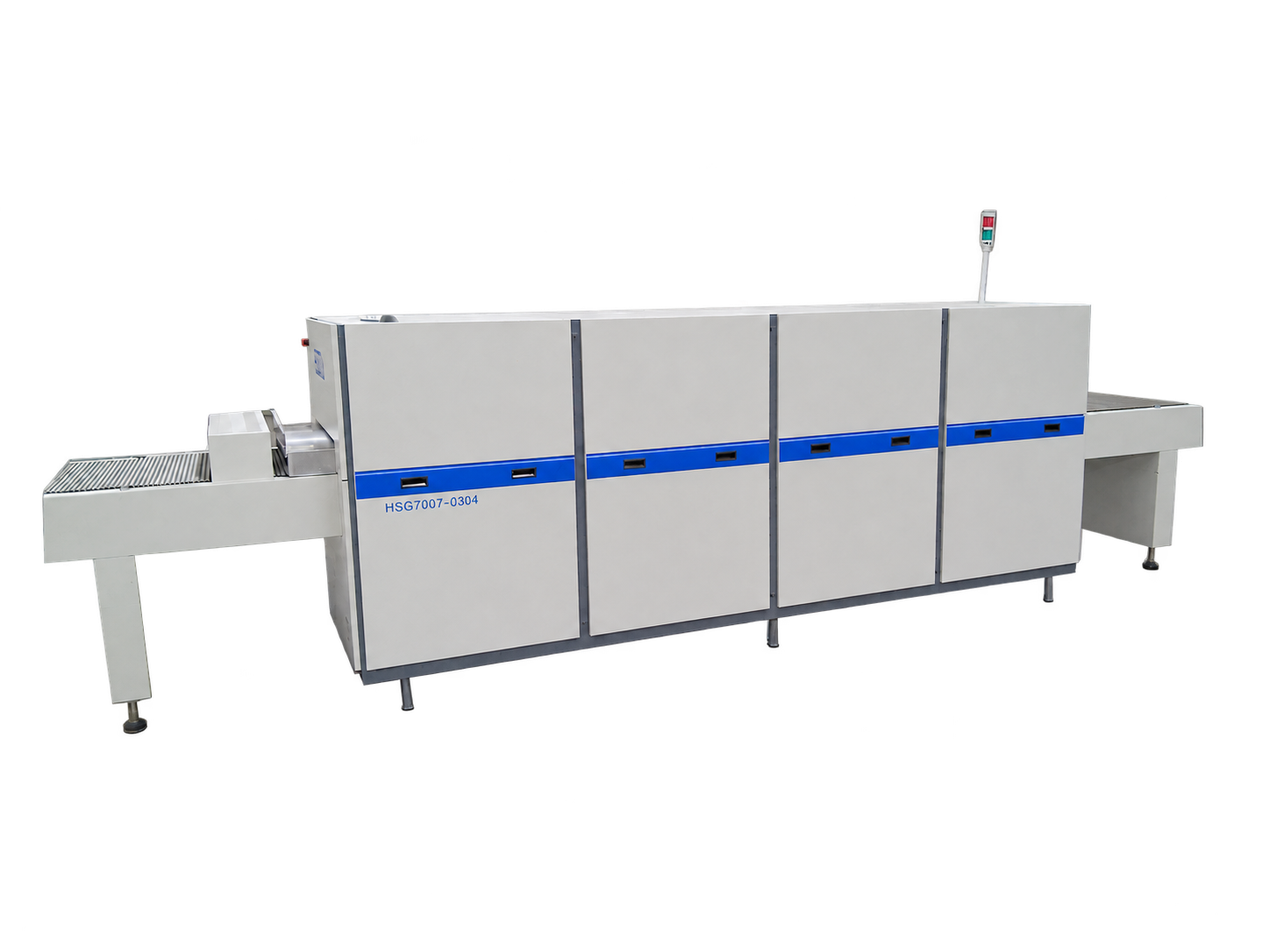
Continuous thick film drying furnaces may use infrared heating or a combination of infrared and hot-air heating. Multi-zone temperature control allows the drying profile to be adjusted along the conveyor, while properly arranged exhaust and airflow design removes evaporated solvents and other volatile materials from the process chamber. An IR drying furnace is one common continuous option.
For production processes with significant organic loading, the location and capacity of gas inlets and exhaust outlets should be developed around the actual vapor-release profile rather than simply increasing total exhaust flow.
Key Thick Film Drying Variables
| Process Variable | Why It Matters |
|---|---|
| Drying temperature | Controls solvent removal and paste stabilization |
| Heating rate | Affects how quickly volatile materials leave the printed layer |
| Residence time / belt speed | Determines the time available for drying |
| Temperature uniformity | Helps maintain consistent drying across the conveyor width |
| Airflow and exhaust | Remove solvent vapor and other volatile constituents |
| Product loading | Changes the thermal and vapor load seen by the furnace |
Multi-Zone Drying Structure
XMZ HSG drying furnaces are available with multiple independently controlled heating zones. The number and length of the zones can be customized based on the paste drying profile, residence time, conveyor speed, product loading, throughput, and exhaust requirements. A typical HSG thick film drying furnace may use three temperature-control zones, while longer or higher-capacity systems can use additional zones as needed.
Thick Film Firing
During thick film firing, the dried substrate passes through a controlled time-temperature profile. Depending on the paste chemistry, the cycle may include organic burnout, development or softening of the inorganic binder phase, formation and consolidation of the functional layer, and controlled cooling.
The objective is not simply to reach a peak temperature. The complete firing profile—including heating rate, burnout conditions, peak temperature, time in the firing region, atmosphere, and cooling—can influence adhesion, film structure, sheet resistance, TCR, and other final properties.
The paste manufacturer's recommended thick film firing profile should normally be the starting point for furnace setup and process development. Conductor, resistor, and dielectric paste firing should be developed around the specific paste/substrate combination rather than treated as interchangeable furnace recipes.
Thick Film Firing Profile
A thick film firing profile describes the actual time-temperature history experienced by the printed substrate as it moves through the furnace. A typical profile includes heating and organic burnout, a peak firing region, and controlled cooling.
Heating and Organic Burnout
As temperature increases, remaining organic binders and other constituents decompose and leave the printed layer. Temperature, time, gas flow, and exhaust must work together during this portion of the cycle. Increasing temperature without adequate removal of decomposition products does not necessarily improve burnout and may create an undesirable local process environment.
Peak Firing Region
The high-temperature region provides the thermal conditions required for the inorganic constituents of the paste to develop the intended fired structure and bond to the substrate. Peak temperature and time in this region depend on the paste system. Conductor, resistor, and dielectric materials may therefore require different firing profiles.
Controlled Cooling
Cooling is part of the firing process rather than simply the end of the furnace. The cooling rate should be compatible with the substrate and fired material system. Excessive thermal gradients can contribute to substrate cracking, dimensional changes, or other process variation.
Product Profile vs. Furnace Setpoints
Furnace controller setpoints do not necessarily represent the temperature experienced by the product. Product mass, substrate size, belt loading, conveyor speed, furnace geometry, and neighboring parts can all influence the actual profile. For process development and production validation, temperature profiling should therefore be performed with representative products and production loading.

Temperature Uniformity and Thick Film Electrical Properties
Temperature uniformity is particularly important in thick film firing because differences in thermal history can contribute to variation in the fired properties of the product. For resistor firing, for example, resistance and TCR repeatability can be sensitive to the firing profile. Differences between products located at the left, center, and right sides of a wide conveyor may therefore indicate a cross-belt temperature-uniformity problem rather than simply an incorrect peak-temperature setting.
Furnace design should consider both cross-belt temperature uniformity and temperature stability through the firing region. Heating-element distribution, furnace insulation, zone configuration, temperature-control strategy, belt loading, and furnace geometry all contribute to the resulting product profile.
Airflow, Exhaust and Organic Burnout
Atmosphere management is another important part of thick film firing. For conventional air-fired thick film processes, clean process air supports organic burnout and helps carry decomposition products away from the printed substrates. The furnace must therefore provide both a controlled thermal profile and an effective gas-flow path.
Gas inlet distribution, exhaust location, furnace pressure, belt loading, and entrance and exit conditions should be considered together. Poor gas circulation or stagnant regions can allow decomposition products to remain around the work, contributing to inconsistent surface appearance or contamination.
- Uniform gas introduction across the working width
- Controlled removal of decomposition products
- Appropriate exhaust capacity for the production load
- A furnace chamber with minimal stagnant-flow regions
- Stable process conditions without excessive uncontrolled air infiltration
For processes generating significant organic vapor or VOC loading, dedicated exhaust treatment may also be considered without disturbing furnace pressure and atmosphere stability.
Multi-Zone Fast Firing Structure
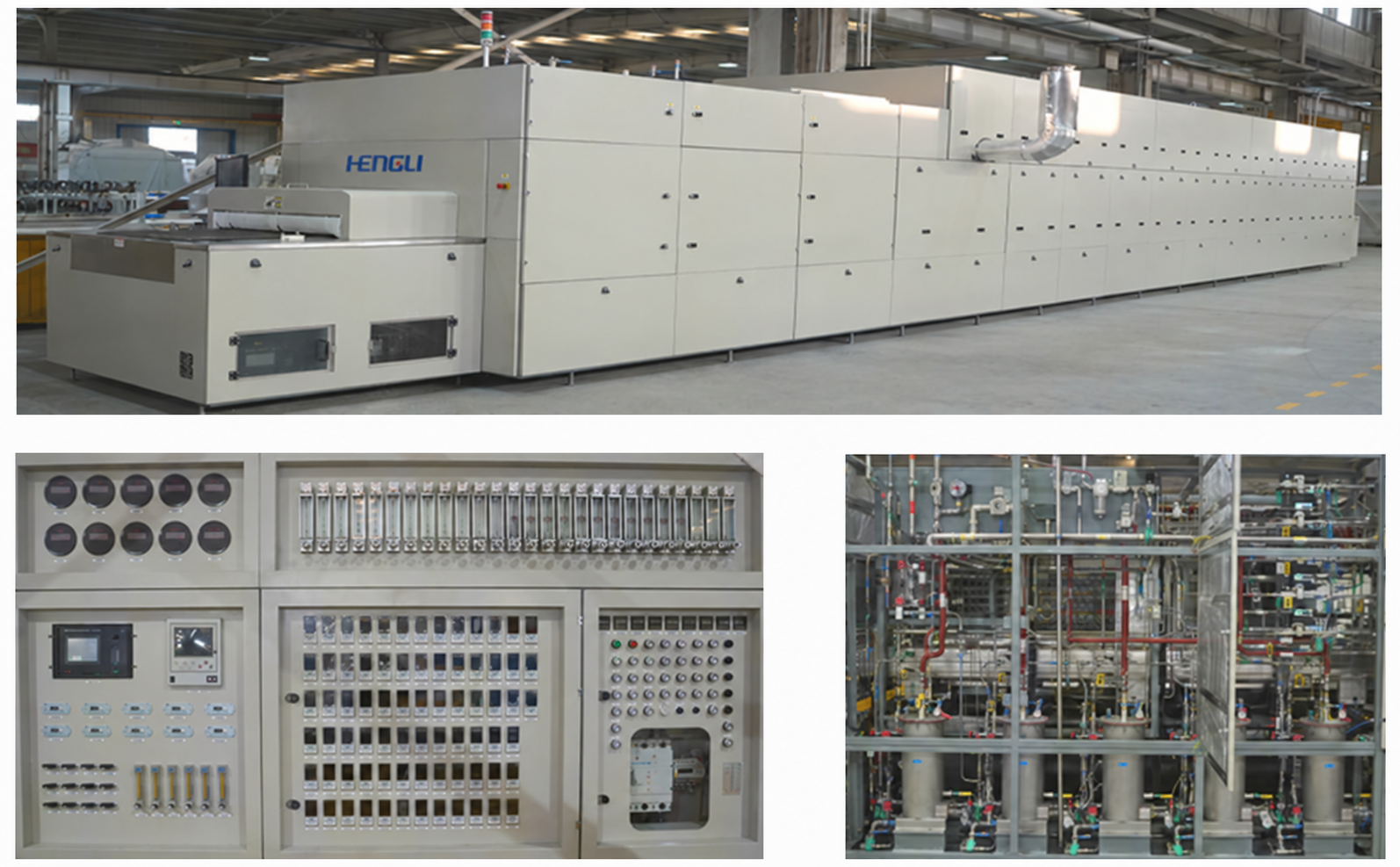
Multiple independently controlled heating zones allow the furnace temperature profile to be shaped along the conveyor. Standard XMZ thick-film configurations commonly use six or seven zones. The number and length of the zones can be customized based on the required firing profile, product loading and throughput. Application-specific integrated drying-and-firing systems can use additional zones; six or seven zones are common configurations, not an absolute HSK platform limit.
Conveyor Stability and Production Repeatability
A repeatable firing profile also depends on stable product transport. Belt speed determines the residence time through each furnace region, so changes in conveyor speed affect heating rate, burnout time, peak exposure, and cooling simultaneously.
For continuous thick film production, the conveyor system should maintain stable speed, belt tracking, and product position while supporting the substrate through repeated thermal cycles. Furnace support geometry, drive-system stability, belt alignment, loading pattern, and belt cleanliness can all affect long-term production consistency.
For sensitive ceramic substrates, heating and cooling rates must also be developed around substrate thickness, dimensions, and thermal-shock sensitivity. These issues become increasingly important for wide-belt and high-volume production.
Air and Controlled-Atmosphere Thick Film Firing
There is no single furnace atmosphere appropriate for every thick film material. Many conventional conductor, resistor, and dielectric thick film systems are fired in clean air. Other materials require nitrogen or a controlled low-oxygen atmosphere.
Copper Thick Film Firing
Copper thick film firing requires particular attention to oxygen control because copper can oxidize at elevated temperature. At the same time, organic constituents must still be removed effectively during the earlier portion of the firing cycle. A copper paste firing process may therefore require different atmosphere conditions through the burnout, high-temperature firing, and cooling sections rather than one constant oxygen level throughout the furnace.
- Separate atmosphere zones
- Independently metered nitrogen and air/oxygen addition
- Zoned oxygen measurement and feedback control
- High-flow binder-removal sections
- Controlled exhaust
- Muffle design to separate and stabilize process regions
- Multi-zone temperature control
- Controlled cooling under the required atmosphere
XMZ’s controlled-atmosphere copper firing technology combines zoned atmosphere control with nitrogen supply, independently metered air addition, oxygen measurement and feedback control. Higher-flow binder-removal sections and controlled exhaust support organic removal, while the high-temperature firing and cooling regions can maintain the oxygen conditions required to limit copper oxidation. This architecture is particularly relevant to copper thick film firing, copper paste firing, MLCC termination and other oxidation-sensitive electronic-material processes.
Thick Film Drying vs. Thick Film Firing
| Factor | Thick Film Drying | Thick Film Firing |
|---|---|---|
| Primary purpose | Remove solvents and stabilize the printed layer | Remove remaining organics and develop the functional fired layer |
| Temperature | Relatively low; often around 100–150°C for conventional processes | Material-dependent; substantially higher than drying |
| Typical equipment | IR or IR/hot-air continuous drying furnace | Multi-zone continuous fast-fire belt furnace |
| Main process variables | Temperature, residence time, airflow, exhaust, loading | Firing profile, uniformity, belt speed, atmosphere, burnout, cooling |
| Atmosphere | Usually air, depending on material | Air or controlled atmosphere depending on paste chemistry |
| Typical XMZ equipment | HSG Series Thick Film Drying Furnace | HSK Series Thick Film Firing Furnace / controlled-atmosphere systems |
Common Thick Film Firing Problems
Resistance or TCR Variation
Variation can be associated with the actual firing profile, cross-belt temperature uniformity, temperature-control stability, belt speed, atmosphere, or upstream printing and material variables. Evaluate the loaded product profile before simply changing peak temperature.
Incomplete Organic Burnout or Surface Discoloration
Uneven gas flow, insufficient exhaust, stagnant regions, or an unsuitable heating profile may allow decomposition products to affect downstream processing and product appearance.
Substrate Cracking
Ceramic substrates can crack when heating or cooling rates exceed what the substrate and product geometry can tolerate. Acceptable rates depend on material, thickness, dimensions, loading, and process history.
Oxidation in Copper Thick Film Processing
Copper oxidation can occur if oxygen concentration is too high in critical high-temperature regions, while inadequate binder removal at lower temperature can create other defects.
Production-to-Production Variation
Changes in loading, belt condition, conveyor speed, atmosphere, exhaust, or product position can change the conditions experienced by the work. Representative product profiling and process monitoring should be part of production validation.
Selecting a Furnace for Thick Film Drying and Firing
A thick film furnace should be selected based on the material, thermal process, atmosphere, and production requirements—not maximum operating temperature alone. Key information for furnace configuration includes:
- Material and product: substrate material and dimensions, paste system, number of print/fire cycles, and product loading.
- Thermal process: paste manufacturer’s recommended drying or firing profile, peak temperature, residence time, heating and cooling rates, and required product temperature uniformity.
- Atmosphere: air or controlled atmosphere, nitrogen and oxygen requirements where applicable, and binder-removal/exhaust requirements.
- Production: required throughput, loading pattern, usable belt width, conveyor-speed range, and operating schedule.
For an established process, an existing product temperature profile is particularly useful. For a new paste or substrate system, process development should normally begin with the material supplier’s recommended conditions and representative production samples.
XMZ Thick Film Drying and Firing Furnaces
XMZ Technologies provides continuous thermal-processing systems for thick film drying, thick film firing, and controlled-atmosphere thick film processing.
HSG Series Thick Film Drying Furnace
The HSG Series is designed for continuous drying and curing of printed thick film materials, with infrared heating, multi-zone temperature control, and controlled exhaust to support a consistent drying profile.
Learn more about the HSG Series Thick Film Drying Furnace →
HSK Series Thick Film Firing Furnace
The HSK Series is a continuous fast-fire thick film belt furnace featuring an ultra-clean, low-mass refractory heating chamber for rapid thermal response. This fast-fire furnace series is rated up to 1,050°C and can heat from ambient to 1,050°C in approximately 40 minutes. Furnace length, temperature-zone configuration, belt width, atmosphere management, and cooling can be customized around the required firing profile and production requirements.
Learn more about the HSK Series Thick Film Firing Furnace →
Controlled-Atmosphere Thick Film Firing
For copper and other oxidation-sensitive thick film materials, XMZ/HENGLI can configure controlled-atmosphere furnace systems with zoned gas control, oxygen monitoring, debinding exhaust, muffle design, and controlled cooling based on the required paste firing process.
Thick Film Turnkey Solutions
For projects extending beyond the drying or firing furnace, XMZ can also support broader thick film production-line planning. Turnkey support can include classic thick film processing steps such as screen printing, drying, firing, and trimming, together with process setup, equipment coordination, and production-line integration.
Frequently Asked Questions
What is the difference between thick film drying and firing?
Thick film drying removes volatile solvents from the printed paste and prepares the deposited layer for firing, typically at a much lower temperature. The thick film firing process follows a defined time-temperature profile to remove remaining organic constituents and develop the functional conductor, resistor, or dielectric layer. Drying and firing therefore require different furnace designs, temperature ranges, residence times, and exhaust conditions.
Why is temperature uniformity important in thick film firing?
Temperature uniformity directly affects the thermal history experienced by products across the belt. For thick film resistors in particular, differences in cross-belt temperature or firing-zone stability can contribute to resistance variation. Furnace design therefore needs to consider both cross-belt uniformity and temperature stability through the critical firing region.
How many temperature zones are needed for a thick film firing furnace?
The number of temperature zones depends on the required firing profile, furnace length, throughput and product loading. Common XMZ/HENGLI HSK thick-film configurations use six or seven independently controlled zones. Other configurations and integrated drying-and-firing systems can use additional zones. Zone number and length are customized around the process rather than limited to one fixed furnace layout.
Why can products across the same furnace belt show different electrical results?
Products processed side by side can experience different thermal histories if cross-belt temperature distribution is not sufficiently uniform. Loading pattern, product position, airflow, and temperature-control stability can also affect the conditions seen by the product. For precision resistor and other electrically sensitive thick film applications, these factors should be evaluated together rather than relying on furnace setpoints alone.
Why are airflow and exhaust important during thick film firing?
Thick film pastes release organic constituents as they are heated. These materials need to be removed from the furnace without creating stagnant regions or disturbing the required process atmosphere. Airflow and exhaust therefore need to be considered together with the heating profile, product loading, and paste system to support consistent burnout and firing conditions.
Why does copper thick film firing require more than simply adding nitrogen?
Nitrogen alone does not define the copper firing process. Organic binders still need to be removed during the lower-temperature portion of the cycle, while excessive oxygen at higher temperature can oxidize copper. A controlled-atmosphere furnace therefore needs to manage gas flow, oxygen level, debinding exhaust, firing atmosphere, and cooling as different parts of the same process.
Can one thick film furnace be configured for different products or firing profiles?
A furnace can often support multiple products when their temperature, atmosphere, residence-time, loading, and cooling requirements fall within the system’s operating range. Independent temperature zones and adjustable conveyor speed provide process flexibility, while applications with substantially different profiles may require additional heating length, atmosphere control, or a different furnace configuration.
What process information does XMZ need to configure a thick film furnace?
The most useful starting information is the paste and substrate system, recommended drying or firing profile, product dimensions and loading, required throughput, atmosphere, belt-width requirement, and any existing product temperature profile. XMZ can use these process requirements to determine the appropriate furnace length, temperature-zone configuration, conveyor speed range, atmosphere/exhaust system, and cooling arrangement.
Discuss Your Thick Film Process
A suitable furnace configuration starts with the paste system, substrate, drying or firing profile, atmosphere, product loading, and production requirement rather than with a standard equipment model.
XMZ Technologies can review applications involving thick film drying, thick film firing, conductor paste firing, resistor paste firing, dielectric paste firing, copper thick film firing, and controlled-atmosphere thick film processing to help define the appropriate furnace configuration.